The Lost-Plate Method: David H. Sekulla and the Slow Art of Dark Imagery
A Brussels printmaker carves the iconography of cold wave — one linocut at a time.
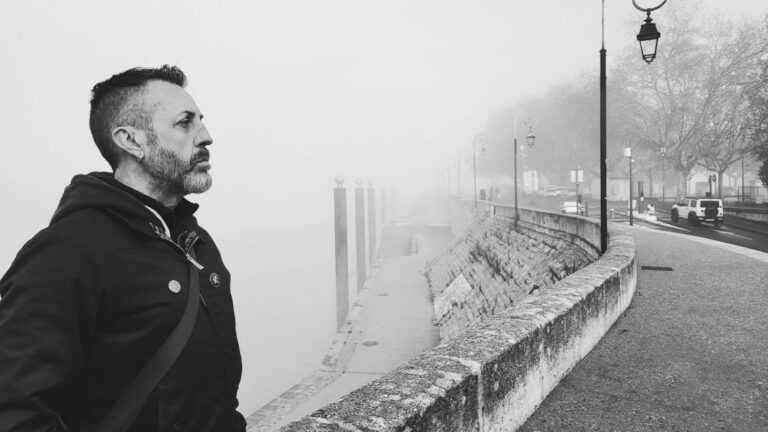
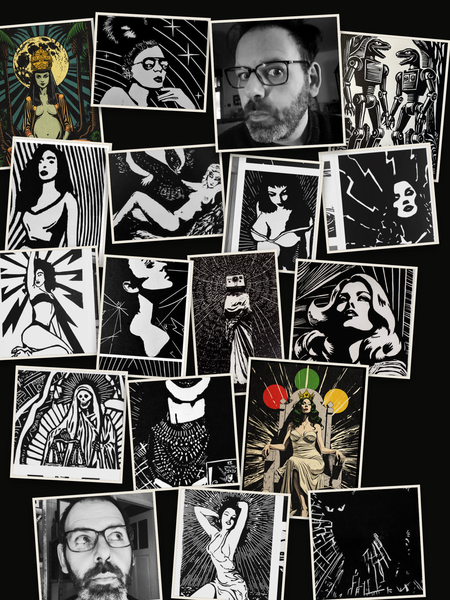
There’s a particular kind of artist the dark scene rarely documents: not the musician on stage, but the one who gives the music its face. David H. Sekulla (aka Yeti Popstar) is a Brussels-based engraver whose linocuts have lately started appearing where post-punk, occultism and pulp Americana overlap: on the cover of a California writer’s “literary tarot,” on the sleeve of a Belgian cold wave record, in a folklorist’s book on English witch-lore. Almost nothing has been written about him. This is, as far as we can tell, the first piece that has.
He didn’t arrive at engraving the obvious way. He arrived through music.
From a CD to a cutting tool
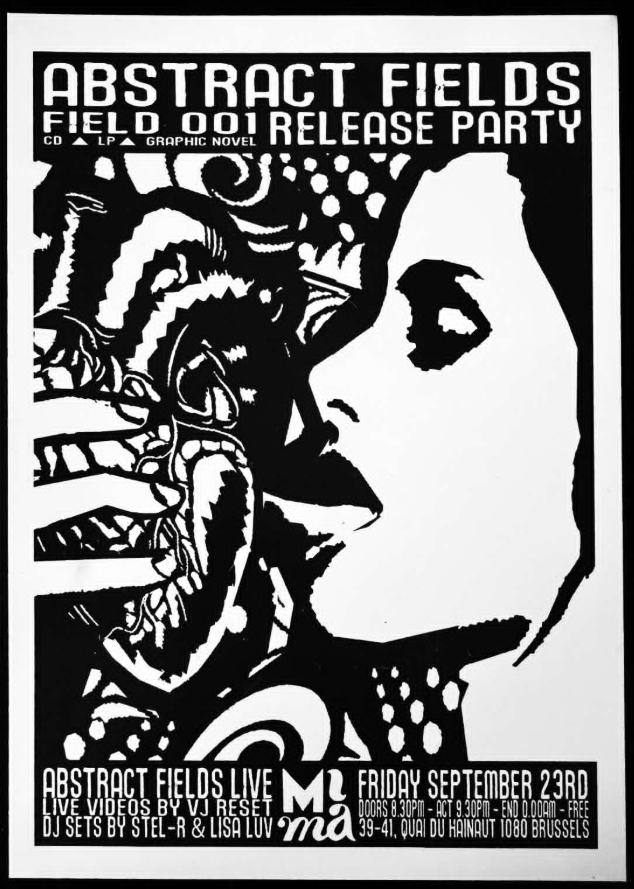
The real starting point was 2014, and a project called Abstract Fields. “A friend wrote texts, and I turned those texts into music,” Sekulla recalls. The idea was to illustrate the songs and the songs would illustrate the texts — a loop that produced a small comic book and a CD. The project barely played live; one of its few outings was a single evening at the MIMA, the now-shuttered Molenbeek museum of culture 2.0, as part of an exhibition. For that show, a friend made a set of engravings. Sekulla, characteristically, decided he wanted in: he cut forty-five of his own, which ended up in the comic alongside a sprawl of collage.
Then he stopped. For seven years he made no prints at all.
What brought him back was lockdown, and a barter. The same friend, bored during Covid, wanted to borrow Sekulla’s photographic enlarger. “I said sure — but what if we trade for your little engraving press?” The deal closed. The press stayed. He’s been cutting ever since.
Pin-ups, monsters and ray-guns
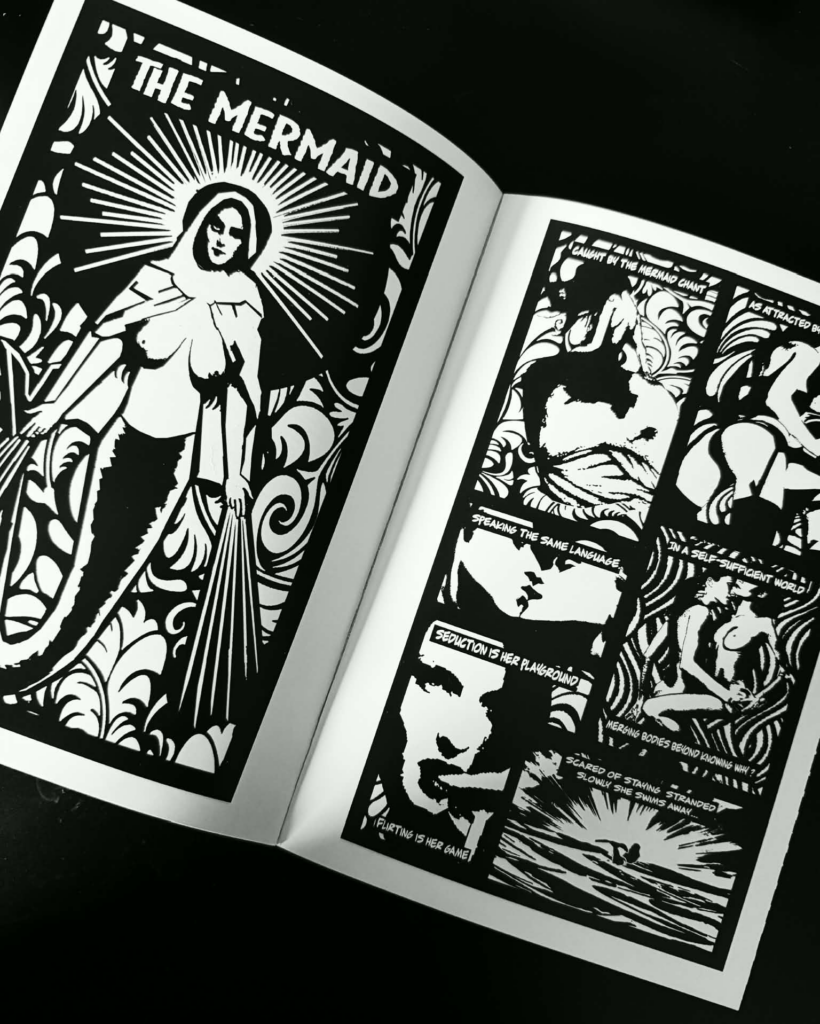
Ask what he was reaching for when he started, and the answer is an aesthetic he’d already been living in: the visual language of his gig posters, of mid-century American pulp. “Pin-ups, monsters and ray-guns,” as he puts it — the comic-book line flattened through a photocopier, 1940s and ’50s pulp-fiction grit. It’s the through-line of his work, and he’s still mining it.
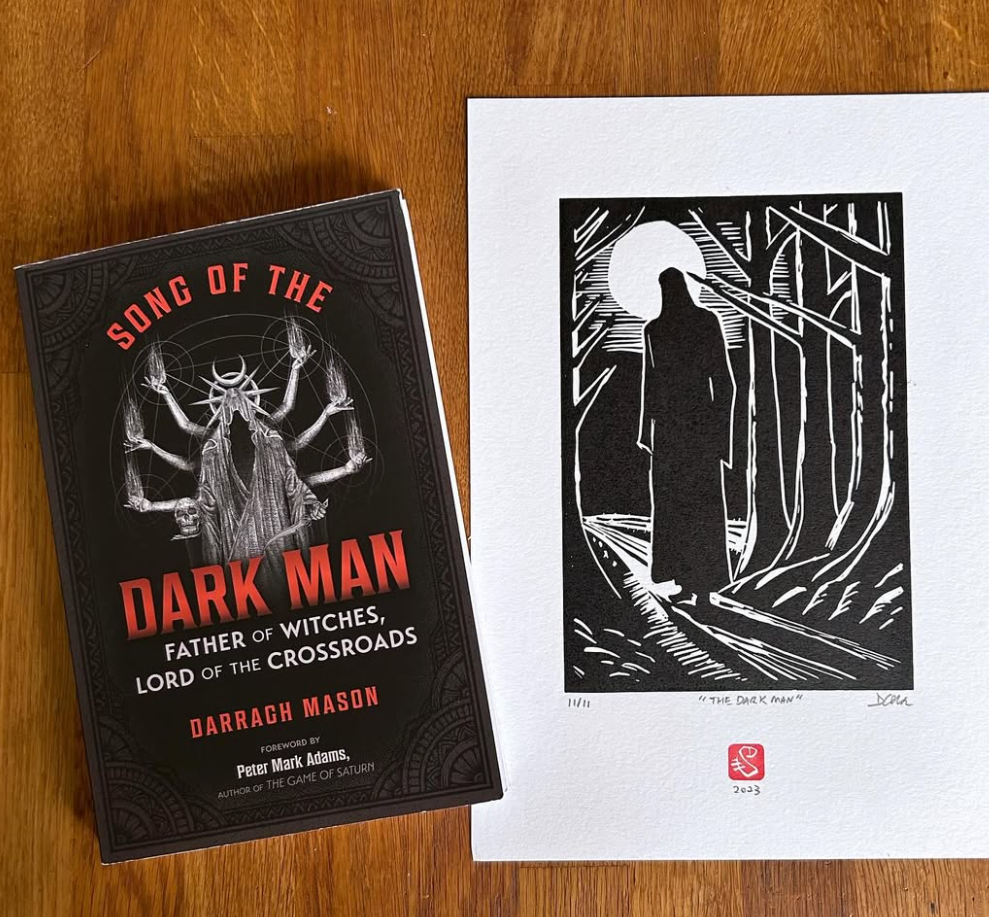
But the catalogue has started to widen. There’s an engraving in a book by the English folklorist Darragh Mason — Songs of the Darkman, a study of the “Darkman” archetype in British and Irish witchcraft folklore. There are other projects he won’t name yet. And there are the collaborations that brought him here: the sleeves, the covers, the commissions that put his knife-cut line in front of new audiences.
The Magician
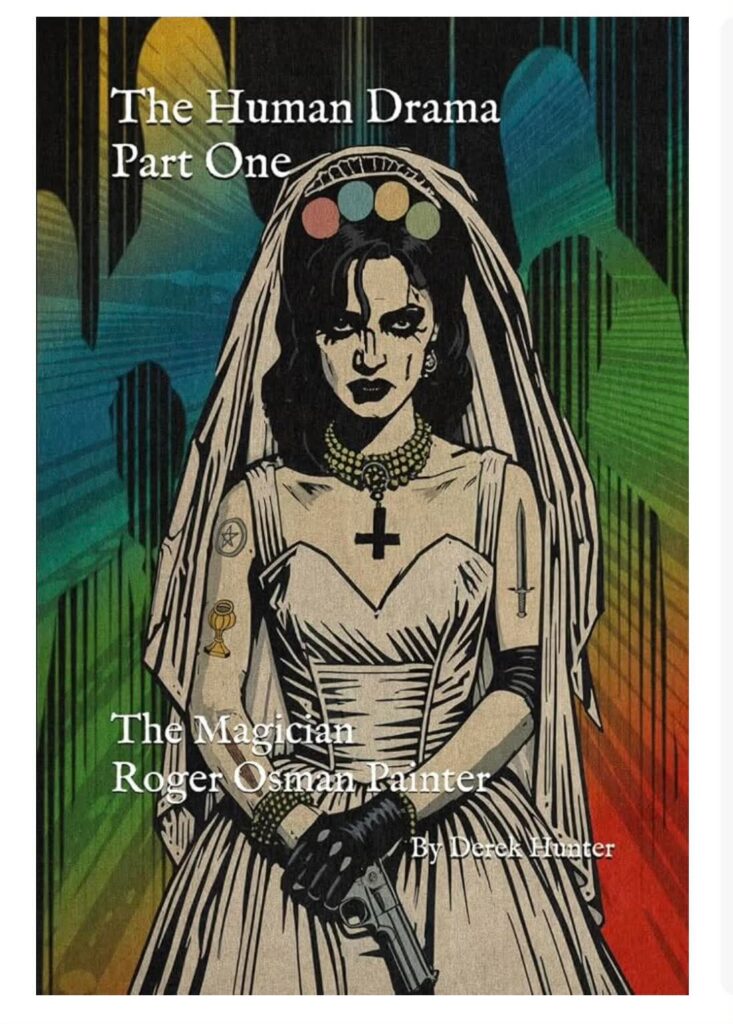
The California connection is the strangest of them, and the most telling. Derek Hunter, a writer Sekulla describes as deep in the occult, is attempting something quixotic: a literary tarot. Not a deck of cards but a cycle of thirty short stories mapped onto thirty tarot cards — three sets of ten, moving from present-day Los Angeles into the future and then the past, a structure Hunter draws from the so-called Mantegna tarot. The first volume — number one, The Magician (the Fool being zero) — is built on Rozz Williams, the late frontman of Christian Death.
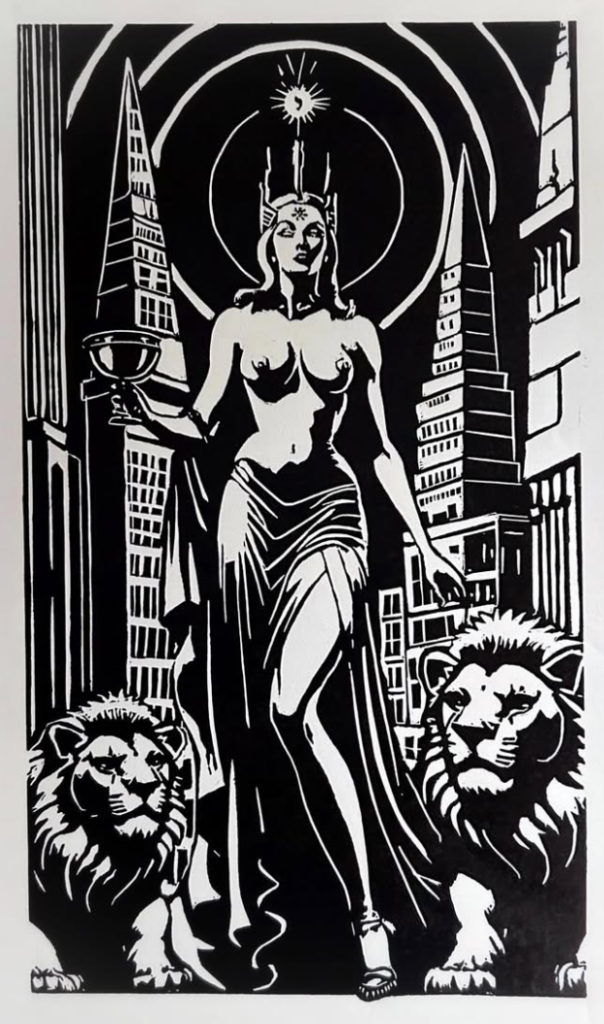
Hunter didn’t find Sekulla by accident, exactly. Sekulla had posted an engraving called Entrance of the Goddess, made after listening to a podcast with Scarlet Imprint, a UK-based publisher of occult limited-edition books. The occult-leaning corner of Instagram noticed; the print got reposted; a small but pointed fan base assembled. Hunter reached out from there.
The brief came with a problem built in. Hunter releases a book on every solstice and equinox — which leaves almost no time to cut a plate. So Sekulla negotiated: “I told him, this one I’ll do in digital — I don’t have time to engrave it.” It’s a candid admission, and a useful one. The man is analog by conviction, not dogma. He refines everything digitally; he keeps a graphics tablet; what matters is where the line wants to live, and how much runway he’s given.
What sold him on the project wasn’t the deadline but the subject. Hunter, he learned, has two enduring obsessions: Christian Death and the Virgin Prunes. “That’s where I liked his choice,” Sekulla says — because those happen to be two of the records he still actually plays. The first Christian Death album, the Virgin Prunes’ Irish-pagan strangeness: not nostalgia, but a living rotation. “There’s plenty I listen to far less than that.” He name-checks the obvious monuments — Joy Division, The Cure — almost wearily.
“I love them, but it’s been a long time since I deliberately put the record on.”
Williams and the Prunes survived the fatigue.
Two hundred decks
The tarot wasn’t a one-off interest, either. Sekulla collects the things. “Two or three hundred decks,” he estimates — and yes, he intends to make his own one day. Seventy-eight cards, one a day if he’s disciplined; he reckons two years of work. “In ten years, it’ll be there,” he says, with the calm of a man who knows exactly how slowly he moves and has made peace with it.
The pull is less religion than its rejection. He calls himself an animist before anything else, and the monotheisms — “all three in the same bag” — hold no appeal. The esoteric does the opposite: if you’re going to be a mystic, he reasons, you may as well go all the way.
KMFDM in black, white and red
The most recent commission is also the most technically revealing. Aveline, a Brussels cold wave / synth artist, needed a sleeve. The connection ran through Laurent Debraz, who’d been doing her flyer illustrations and decided his own small drawings wouldn’t carry the cover. So they came to Sekulla, and briefed him well. He showed them a vaguely Soviet block-lettering reference; the palette locked itself in.
“I told them, let’s make a KMFDM sleeve.” Black, white, red. That, more or less, is what they made.
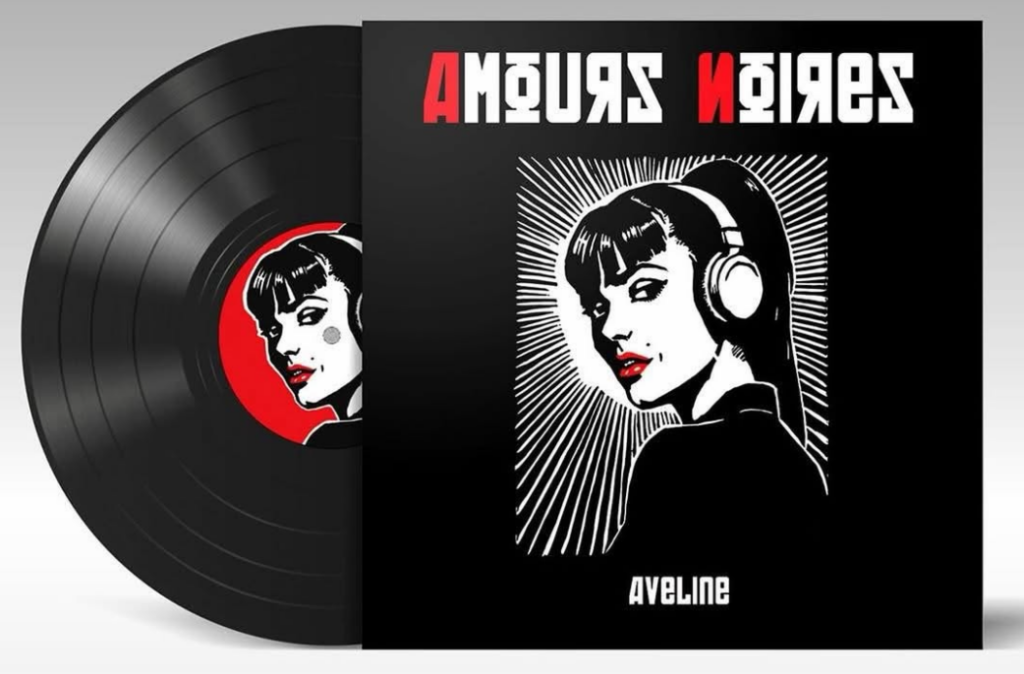
The method is worth slowing down on, because it’s where the craft shows. Sekulla cut it as a reduction print — plaque perdue, the lost-plate technique. He printed the whole image in red first, then carved further into the same block and reprinted in black over the top, so that only a few elements — the lips — survive from the first pass. The plate is destroyed in the making; the edition can never be re-run. Fifteen copies exist, bundled with a limited run of the vinyl. The accident is the point: “there’s always something” that slips between the image in his head and the cut on the block, and he’s stopped fighting it.
The scene, and its grey hairs
Sekulla has watched the Brussels dark scene from inside it for decades — he spent years booking shows at the DNA, the legendary Brussels alternative music café, a stretch he remembers fondly and has no wish to repeat. “At the start it’s exciting. By the end, when you’re at your third metal show of the week, it wears.” When people later nudged him toward a programming job at the Café Central, he started drafting a CV and stopped himself. Five years of nights had been enough; for a long while afterward he was simply happy to stay home.
So when he assesses the current cold wave moment, it’s with a booker’s clear eye and no flattery. The good news and the bad news are the same observation. “What I see is that it’s old people,” he says — the scene endures, but it isn’t visibly renewing itself from below. He qualifies it immediately, because the picture isn’t uniform: at a recent Cabaret Voltaire show, there were the usual veterans but also genuinely young goths “coming out of their caves.” On Bandcamp, the cold wave / post-punk seam runs deep. At the Botanique, the post-punk bills pull real, age-spanning crowds. The music didn’t die. It just got older along with the people who first loved it — Sekulla included, who places himself, with a shrug, at fifty-three.
The story you tell yourself
What does he wish people noticed in his work that they don’t? The answer is quiet, and it reframes everything above. Each piece has a title. “Sometimes the title has no relationship — in my head it does, but I don’t say which one — with the image,” he says. “I want people to tell themselves their own dumb little story.”
It’s an unexpectedly generous position for an artist whose surfaces are so emphatic: the heavy black line, the pulp monsters, the lost-plate lips printed in red. He cuts the image down to its starkest form, then hands the meaning over. The plate gets destroyed; the story stays open.
David Sekulla’s work can be found on Instagram as @yetipopst_art. The Magician, the first volume of Derek Hunter’s thirty-part literary tarot cycle features his cover. Aveline’s vinyl ships with his limited reduction-print sleeve.
Text © 2026 Ian Joy / Catastrophe Ballet — CC BY-NC 4.0. Artwork © David H. Sekulla, reproduced with permission.