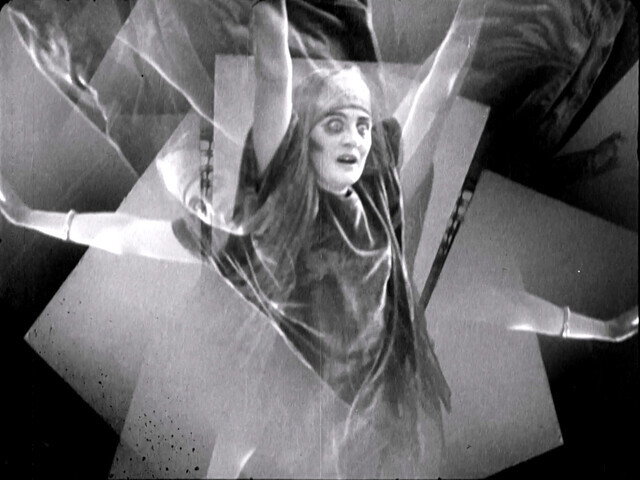
In 1926, amateur filmmakers James Sibley Watson Jr. and Melville Webber began adapting Edgar Allan Poe’s Gothic novella into an experimental thirteen-minute film shot in a Rochester stable with minimal equipment and resources. Rather than recreating the narrative literally, they constructed an avant-garde visual equivalent of Poe’s psychological claustrophobia, employing distorted text cards, disembodied gloved hands, kaleidoscopic optical effects, and expressionist makeup to convey dread and dissolution. Protagonist Roderick Usher appears vampiric and increasingly unmoored as imagery fragments and dissolves; his sister Madeline manifests as a ghostly figure wrapped in ritualistic garments. The production, recognized as pioneering American avant-garde cinema, eschews conventional dialogue except for scattered words like SCREAM and CRACK, instead relying on visual deterioration and surrealist imagery—cascading hammers, overlapping forms, and architectural collapse—to evoke the story’s descent into madness and the house’s destruction. Webber, an archaeologist and painter, and Watson, a cultural patron, brought professional artistic vision to their deliberately constrained amateur filmmaking.
Original article published on Public Domain Review — AI-generated summary. Visit the website to read the full article at the source. Image via Public Domain Review.