Wreckers of Civilisation, Fifty Years On
Throbbing Gristle, Coil, Ministry and the subscription to one’s own heritage
In 1976 it took the tabloids to tame Throbbing Gristle. In 2026 the scene does the job itself — and pays for it in advance.
Same building. Same date. Fifty years apart.
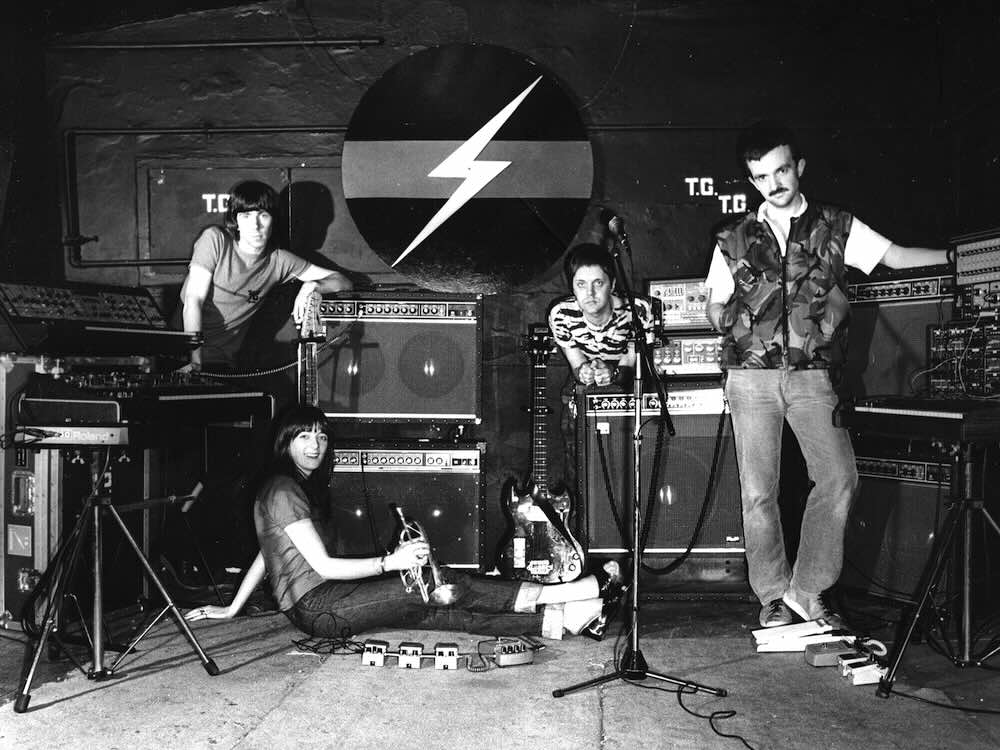
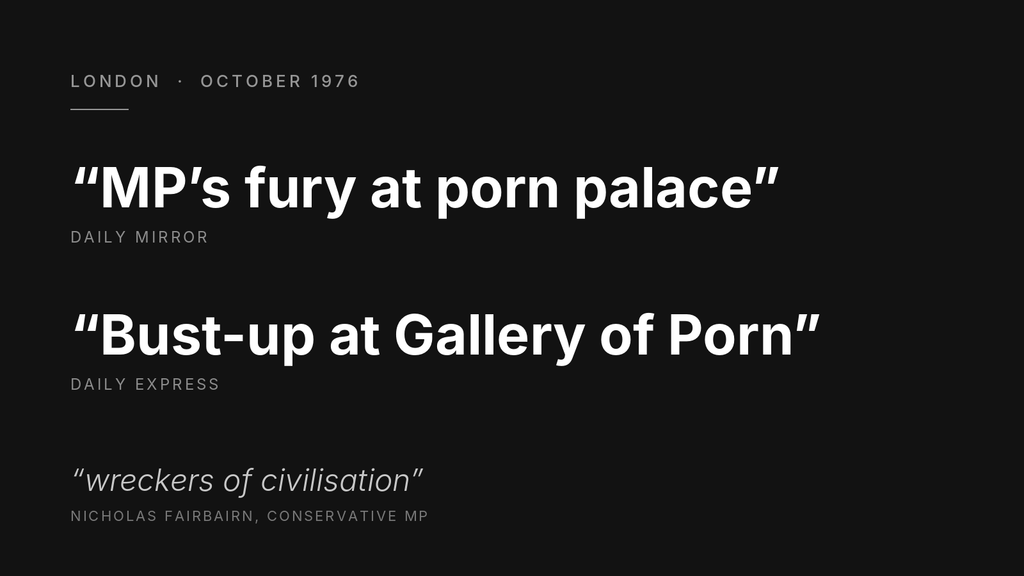
On 18 October 1976, COUM Transmissions opened Prostitution at the Institute of Contemporary Arts in London, a short walk from Buckingham Palace. The exhibition hung Cosey Fanni Tutti’s work in pornographic magazines on the wall, framed, as art. Throbbing Gristle gave what is remembered as their debut gig on the opening night, though they had already played in public that summer, at the AIR Gallery. The anniversary material dates the band’s activation to 3 September 1976; most histories, and Mute’s own copy a few weeks earlier, say 1975. Even the birth certificate is open to revision. The tabloids did the rest. A Conservative MP, Nicholas Fairbairn, called the people responsible “wreckers of civilisation” — the phrase Simon Ford later borrowed for his history of COUM and Throbbing Gristle.
On 18 October 2026, the ICA hosts TG50: a day of screenings, talks and music marking fifty years of Throbbing Gristle, organised with Mute. Chris Carter and Cosey Fanni Tutti will be in conversation with the journalist Luke Turner, then sign for the queue. Entry to the building is free; the screenings and talks are ticketed, capacity limited. A new line of TG merchandise launches the same day, some of it available only on site.
The story everyone expects from those two dates is the oldest one in the subcultural book: rebels absorbed, scandal turned souvenir. It is true, and it is not very interesting. What has changed since 1976 is the audience.
The folk devil
In Subculture: The Meaning of Style, Dick Hebdige describes recuperation in two forms. The first is commercial: subcultural signs converted into mass-produced objects. The second is ideological: deviant behaviour labelled and redefined by dominant groups — the police, the media, the judiciary. Within the second, borrowing from Barthes, he finds two strategies. The Other can be made into pure spectacle, a monster or a clown, and placed beyond analysis. Or it can be trivialised, naturalised, domesticated, until difference is simply denied.
The autumn of 1976 is the first strategy in textbook form. Nobody argued with Throbbing Gristle. They were exhibited a second time, in newsprint, as freaks. Fairbairn’s phrase installed them in the place where common sense keeps its monsters.
In Hebdige’s account the agents of recuperation stand outside the subculture: editors, magistrates, manufacturers, fashion houses. His perfect example dates from September 1977, when Cosmopolitan reviewed a Zandra Rhodes collection built on punk — jewelled safety pins, wet-look satin — and closed on an aphorism: to shock is chic.
But Hebdige also noticed that punks willingly played the part of folk devil, presenting themselves as pure objects, as villainous clowns. COUM had been at it for years before the punks. Prostitution was built to draw exactly the headlines it drew, and as the cuttings came in they were added to the show, day by day. The machine was not resisted. It was operated.
S. Alexander Reed, in Assimilate, puts a limit on that kind of victory. A single bomb — he names Prostitution — can’t explode eternally.
The jubilee

Image courtesy of the artists.
Fifty years later the second strategy takes over: the monster becomes heritage, programme, anniversary, merchandise table. The two forms of incorporation, Hebdige wrote, can be said to converge on the commodity form. TG50 puts the commemoration and the merchandise in the same building on the same day.
The band, at least, has not changed its method. Carter and Tutti, with Mute, run the jubilee themselves, as COUM once ran its own scandal, with the same lucidity about how attention is made and spent. In 1976 they fed the press its own clippings. In 2026 they set the programme of their own commemoration.
Who runs it also decides who is missing. Genesis P-Orridge died in 2020, and the most mythologised member of the band has no voice in its jubilee — a figure whose account of those years Cosey Fanni Tutti has spent a memoir contesting. The split predates the death. In October 2010, P-Orridge left the re-formed Throbbing Gristle in the middle of a European tour, and the others carried on as X-TG.
The catalogue
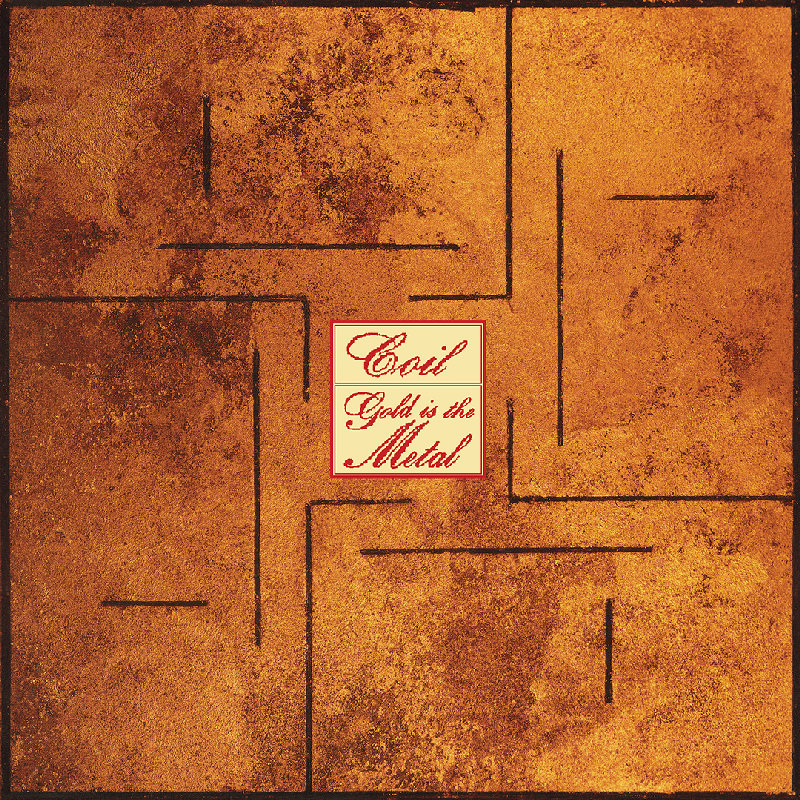
On 4 December, Mute releases TG24+: thirty-six concerts, restored and remastered by Carter, on a USB drive. The title points back to TG24, the box of live cassettes Industrial Records put out at the turn of the eighties. Throbbing Gristle documented their own shows and sold the documents by mail order from the start. The band that was going to wreck civilisation was also keeping very good records, and it is still the one keeping them.
On 30 October, Coil’s catalogue starts coming back through Threshold House, the label revived by Stephen Thrower and Ossian Brown — both former members of Coil — in partnership with Mute and in association with the estates of John Balance and Peter Christopherson. Mute now stands behind both catalogues. The series opens with Gold Is the Metal, followed by the soundtrack to Derek Jarman’s The Angelic Conversation, the unreleased music Coil wrote for Clive Barker’s Hellraiser and the compilation Unnatural History. It does not start with Scatology or Horse Rotorvator. Mute’s own announcement calls those two “revered” and admits that the period immediately after is “sometimes skipped over” — the years when, in the label’s words, sex and sexuality were “cast under increasing shadow by homophobia and the fear of AIDS”. The heirs chose to begin with the part of the catalogue that had been left in the dark. The thread between the two catalogues is Christopherson, who went from Throbbing Gristle to co-found Psychic TV with P-Orridge, then left with Balance to make Coil. Simon Reynolds once wrote that being a fan of either band was like enrolling in a university course of cultural extremism. The course is now available in remastered editions, curated, quite literally, by the faculty.
The subscribers
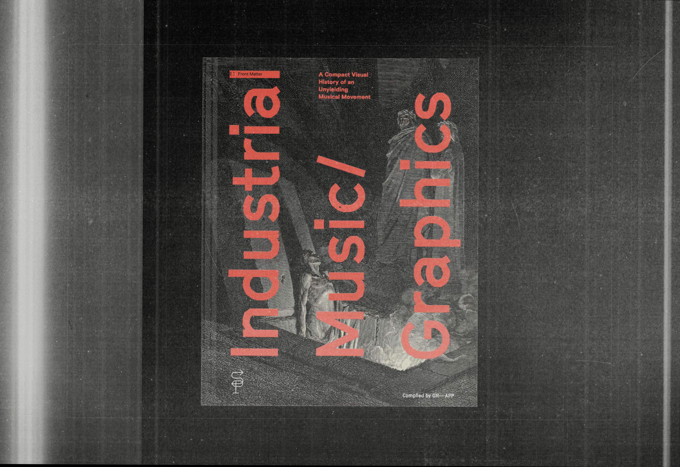
Then there is the book. Industrial Music/Graphics, from SIGNALS Press, traces the genre’s visual language from Throbbing Gristle to Nine Inch Nails, told by the designers who made it. It was put to the audience on Kickstarter, and the audience paid: $36534 pledged by 387 backers.
This is the case Hebdige’s model has no room for. In 1979, conversion into commodities happened to a subculture, from outside, usually against its will and always at someone else’s profit. Here the people converting the signs are the ones who drew them, and the people paying for the conversion are the ones who grew up on them, months before the object exists. The scene is not being incorporated. It is crowdfunding its own incorporation, at a pledge level of its choosing.
Nothing in that is cynical. The designers deserve the book, and the audience plainly wants it. That is the point. The domestication Hebdige attributed to editors and manufacturers no longer needs them. It happens out of affection.
A second mechanism
Ministry release Hate To Go on Cleopatra on the same 30 October, billed as their final album, ahead of a farewell tour that reaches Europe next spring.
They do not fit Hebdige’s scheme, and they should not be forced into it. Ministry were never a scandal waiting to be tamed. They came from the other industrial — Chicago rather than the art school, arenas rather than galleries — and they were a commercial proposition from early on. What they show is a different mechanism, one Reynolds called retromania: a culture so attached to its own past that it keeps consuming its endings.
This is not Al Jourgensen’s first goodbye. The Last Sucker was announced as the end in 2007, From Beer to Eternity in 2013. The ending has become a format, and formats repeat. The European dates come with meet and greet packages: a photo with the band, a commemorative laminate, a screen-printed poster, a final European tour coin. Throbbing Gristle’s scandal needed fifty years to become a souvenir. Ministry’s farewell is sold as one on the day it is announced.
The two mechanisms start in different places and end in the same one. Whether it is an inheritance or a goodbye, the audience buys it for the same reason the book got funded: affection.
Never stop
The archive is better than the void, and the people who made this music are entitled to be paid for it. Cosey Fanni Tutti, who was turned into a headline in 1976, now has a hand in how that headline is remembered.
But the bomb has gone off. What remains is the procedure Hebdige described, with one part rewired: the monster made familiar by the monsters themselves, the familiar made merchandise by the people who love it.
Reed, after conceding that a single bomb can’t explode eternally, offers the only answer the genre ever had: industrial works as a programme, not as a monument. He borrows it from a Belgian band. Front 242 put it in two words. Never stop.
Ministry play the Ancienne Belgique on 4 April 2027. It will be loud, and it will be the last time. Again.
Other Voices — the newsletter
Get the best of coldwave and post-punk in your inbox, once a month. No noise, no spam.
Text © Ian Joy / Catastrophe Ballet, licensed under CC BY-NC 4.0.